
The Data-Driven MARS Method for Selecting the Best Comparables: FAQs
In our January 2026 issue, we introduced you to our new MARS (Multi-Attribute Ranked Search) method for identifying the best comparables. Last month, in the second part of our three-part series on MARS, we walked you through a hypothetical case to illustrate the different outcomes you’d obtain from a traditional manual search versus a traditional search enhanced with the MARS method.
In the final part of our series, we’ll address some of the questions you might have about bringing a new automated tool into your valuation workflow. We’ll clarify what MARS does and doesn’t do, explain how it aligns with sound valuation practice, and identify some ideal scenarios for using MARS — as well as some where the traditional manual method alone may prove preferable.
MARS in a Nutshell
In a world where valuation experts’ access to data and databases is growing every day, new tools are necessary to analyze the vast amounts of data — and that’s where MARS comes in.
Valuators typically begin by searching a transaction database applying a series of individual filters. A number of candidate comparables is eventually produced, and the valuator determines which to use in the valuation. MARS expands this valid approach by simultaneously assessing more attributes that might be comparable. This is the essence of the MARS process.
While a resulting transaction might not be a perfect match with the subject, it may match on several of the attributes. It evaluates multiple attributes to find and score comparable transactions. It provides a data-driven analysis, rather than a qualitive “eyeball” analysis of the data. Instead of filtering on one or two criteria, MARS simultaneously assesses five attributes (industry, revenue, date, location, and business description).
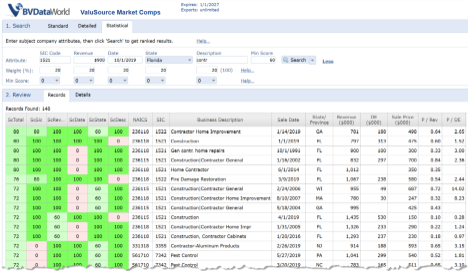
Figure 1: MARS User Interface example – The interface allows input of the five attributes and displays a ranked list of comparable sales with their scores.
FAQs about Adopting MARS
Q.1: How does MARS interact with my professional judgment?
A: MARS is explicitly designed as an analysis tool that can handle the time-consuming task of scanning and ranking comparables. Your expertise remains at the heart of the valuation process. MARS is there only to back you up with data-driven insights.
MARS doesn’t determine which comparables you use in your analysis, and it can’t interpret the nuances of those comparables in the context of your valuation — that remains your job. MARS is more like a research assistant who provides you with a well-organized report of potential comps. You review that report, make decisions, and apply your expertise in the analysis. In fact, using MARS can streamline your work by freeing up time and mental energy that you would otherwise spend on data gathering to focus more on analysis, adjustments, and crafting your final valuation report.
Q.2: Is MARS a “black box” algorithm?
A: No, MARS is a transparent framework. The five attributes it uses are standard data points that you’d likely consider as part of your process. Moreover, the scoring system is rule-based and can be explained in plain language (for example, MARS gives 100 points for an exact industry match and 80 points for the same industry group). In other words, it’s essentially automation of best practices in comparable selection.
Your seasoned judgment is the filter on top of the algorithm’s output. If a particular transaction comes up that you feel isn’t a true comp upon closer inspection, you simply exclude it from your final set. MARS’s role is to ensure you’re aware of the candidates; your role is to select the best among them.
Q.3: How do I defend a MARS-based selection to a client or in court?
A: Using MARS makes your defense easier, adding an extra layer of credibility to your selection process. You can still explain comparables in narrative form — MARS doesn’t change the story of why a comp is relevant — but now you can preface that with: “We employed a systematic search algorithm, which ranked potential sales by similarity, to ensure objectivity in identifying comparables. The transactions we chose scored above 85 on that scale, indicating a very high degree of similarity to the subject company across multiple factors.” This kind of explanation shows that you employed a robust method.
MARS gives you a quantitative backing that fortifies your qualitative explanation. In litigation settings, for example, if an attorney claims you chose inappropriate comps, you can demonstrate that an algorithmic process was used to develop a comparable transaction list. In short, MARS helps you build a data-driven justification for your comparables that complements your expert rationale.
Q.4: Is MARS difficult to use or learn? I don’t want complicated software that slows me down.
A: Many users find that using MARS is faster and more intuitive than manually juggling multiple search filters. It’s designed to be user-friendly, especially as it’s integrated into the valuation tools.
The interface in ValuSource’s system, for example, is straightforward: You simply enter the five attributes and click search. The output is presented in a clear ranked list with scores. The ranking is intuitive, with higher scores showing a comp is more similar to the subject.
The software handles the heavy lifting in the background. It’s up to you to read the results and make the critical choices.
Q.5: Can I restrict MARS to find only comps in the same industry?
A. Absolutely. You can set the industry score match to 100 to exclude any comps from a different industry. It will, however, affect the MARS output and general strategy.
Ideal Scenarios for Using MARS
As powerful as MARS is, it’s important to recognize the contexts in which it provides the greatest benefit. You’ll find MARS particularly helpful in the following circumstances:
- Limited Results: If traditional filtering provides only a narrow list of potential comparables, MARS is ideal. It will apply the multiple attributes to deliver a broader list, with more transactions.
- Early in the Valuation Process (Exploratory Phase): Running a MARS search early on gives you a sense of what’s out there and how various potential comps score. This can inform your subsequent analysis.
- Ensuring Defensibility and Documentation: When you anticipate that your choice of comparables will be scrutinized (by a client or in court), using MARS adds an element of rigor to your process. It makes it difficult to deny that you followed a disciplined methodology.
- Valuations in Inactive Industries: MARS can help you overcome the difficulty of finding comps for a business in an industry with few transactions. Because it looks at description text and related codes, MARS can catch, for example, a comp involving a company classified under a different code but with a description very similar to the subject.
- Complex Cases with Multiple Important Factors: Some valuations have particular nuances. Maybe both location and industry weigh heavily in the determination of comparability. In such multi-faceted situations, MARS’s holistic approach shines by allowing you to adjust attribute weights appropriately.
However an expert decides to filter the database, the explanation of how the comparable transactions were selected will be crucial to the conclusion of value. MARS provides a more robust way to find those transactions, with data to support why they were selected.